
Linguistic Reasoning (AI’s Current State) — Is It Real Reasoning?

Updated: Mar 13
The Ghost in the Syntax: Linguistic Reasoning and the Architecture of Mind

For as long as we’ve had language, we’ve treated it as the ultimate receipt of thought. If someone can explain a complex political theory or solve a riddle using words, we assume there is a "thinker" behind the curtain, weighing evidence and connecting dots.
If an entity provides a perfectly logical answer to a profound question, has it performed an act of reasoning? This inquiry sits at the heart of our contemporary fascination—and growing unease—with large language models. When a machine produces a cogent essay on the ethics of stoicism or solves a complex programming riddle, the output is often indistinguishable from human intellectual labor. Yet, the mechanism beneath is a vast sea of statistical probabilities, a "next-token" prediction engine that operates on a scale of data no human could ever consume. This brings us to a fundamental fork in the road of cognitive science: is linguistic manipulation a sufficient condition for reasoning, or is it merely an elaborate simulation of the shadows cast by a deeper, non-linguistic form of thought?
How AI Actually Reasons: The Statistical Mirage of Intelligence
To understand the current state of artificial intelligence, one must first look at the architectural transition from rule-based systems to the connectionist paradigms that dominate today. In the early days of "Good Old-Fashioned AI" (GOFAI), reasoning was envisioned as a top-down application of formal logic. If the system knew that "all men are mortal" and "Socrates is a man," it could deductively conclude that "Socrates is mortal." This was reasoning by design—transparent, symbolic, and brittle. Modern large language models (LLMs) operate on a fundamentally different premise. They do not have a hard-coded list of logical rules; instead, they have internalized the statistical structure of human language through exposure to trillions of words (Hinton, 2023).1

The debate over whether this constitutes "reasoning" is perhaps best captured by the intellectual friction between Noam Chomsky and Geoffrey Hinton. Chomsky, the father of modern linguistics, argues that the human mind possesses an innate "language faculty"—a biologically determined mechanism that allows a child to produce an infinite array of sentences from a limited set of inputs, a phenomenon known as the "poverty of the stimulus" (Chomsky, 2023).1 For Chomsky, LLMs represent a form of "high-tech plagiarism" because they lack a genuine understanding of the underlying principles of grammar and reality. They are, in his view, merely matching patterns across extensive datasets without any cognitive mechanism for truth or causality.1
Conversely, Hinton, a pioneer of neural networks, contends that the success of these models actually disproves the necessity of an innate universal grammar. He suggests that linguistic competence and the reasoning it implies can emerge entirely from data-driven processes (Hinton, 2023).1 In this view, the "reasoning" observed in models like GPT-4 is not an illusion but an emergent property of high-dimensional vector spaces. When a model predicts the next word, it is not just guessing; it is navigating a latent space of concepts where "king" minus "man" plus "woman" equals "queen." This mathematical interpolation suggests that the model has captured something essential about the relationships between ideas, even if it lacks a biological brain.4
The "reasoning" we see in AI is often characterized by what psychologists call System 1 thinking: fast, intuitive, and pattern-based (Kahneman, 2011).6 When an AI generates a response, it is performing a high-speed version of the same mental process we use to finish a common phrase like "war and..." or "2 + 2." However, human reasoning also involves System 2: a slow, deliberate, and logical process used for complex problem-solving (Kahneman, 2011).8 Recent attempts to "force" AI into System 2 thinking, such as Chain-of-Thought (CoT) prompting, involve asking the model to "think step by step." While this improves accuracy, critics argue it is still just a linear sequence of System 1 predictions, rather than the global, reflective deliberation that a human brain performs when it pauses to reconsider its own logic.5
Cognitive Feature | Human Reasoning (Biological) | LLM Reasoning (Digital) |
Primary Mechanism | Neural "wetware," chemical/electrical signals 11 | Silicon-based hardware, back-propagation 1 |
Learning Style | Embodied, social, low-data 12 | Disembodied, statistical, massive-data 1 |
Information Speed | Conduction velocity ~120 m/s 11 | Signals propagate near light speed 11 |
Communication | Language/Gestures (Low bandwidth) 11 | Direct high-bandwidth digital connection 11 |
Energy Efficiency | High (~20 watts for the whole brain) 11 | Low (Massive server farms) 11 |
Reasoning Mode | System 1 (Intuitive) & System 2 (Logical) 7 | Primarily System 1; simulated System 2 5 |
Beyond the immediate mechanics, there is a certain "opaqueness" to how these models arrive at their conclusions. Unlike a human who can reflect on their motivations or a symbolic AI that follows a trace of rules, a transformer model's "reasoning" is distributed across billions of parameters. This creates what researchers call an "AI unconscious"—a structural reality of deep learning where vast latent spaces and recursive symbolic play allow for behaviors that surpass explicit programming (2025).15 This opaqueness is precisely what makes the question of "real" reasoning so difficult; we see the output, but the path taken is a statistical manifold rather than a conscious logical chain.
The Mathematical View of Reason: Gödel, Turing, and the Incompleteness of Machines
If reasoning is the manipulation of symbols according to rules, then mathematics should be the ultimate proof of machine intelligence. However, the history of mathematical logic suggests that even the most perfect formal systems have "holes" that no algorithm can fill. This brings us to the profound interplay between Kurt Gödel and Alan Turing. In 1931, Gödel published his Incompleteness Theorems, which proved that in any consistent formal system capable of basic arithmetic, there are statements that are true but cannot be proven within that system.16

Gödel’s work suggests a fundamental limit to "mechanical" reasoning. If reasoning is strictly a matter of following a finite set of rules (like a computer program), there will always be truths that remain out of reach. Turing, in developing his concept of the Universal Turing Machine, addressed the same problem through the "Halting Problem," demonstrating that no general algorithm can exist to determine whether a given program will eventually stop or run forever (Turing, 1936).16 These results defined the "potentialities of pure formalism" but, crucially, Gödel did not believe they defined the limits of human reason.17
In a later critique of Turing's work, Gödel pointed out what he called a "philosophical error." Turing had argued that because the human brain is a physical system with a finite number of states, it must be equivalent to a machine (Turing, 1950).17 Gödel countered that the human mind is not "static" but "constantly developing" (Gödel, 1972).17 He argued that as we use abstract terms, our understanding of them deepens, allowing us to form new axioms and insights that go beyond our previous "mechanical" state. He cited the ongoing development of set theory—where mathematicians continuously find "stronger and stronger axioms of infinity"—as evidence of a mind that "converges toward infinity" through its own use.17
The mathematical representation of this limit is often shown through the Gödel sentence G, which effectively constructs a statement within a system that asserts its own unprovability:

If the system S is consistent, the statement must be true, but it cannot be proven by S.18 A human mathematician, looking at the system from the outside, can see the truth of G through an act of intuition that bypasses the formal proof chain. This "insight" is what Lucas (1961) and Penrose (1994) later used to argue that human minds cannot be explained as mere machines.21 They suggest that there is at least one thing a human mind can do that a machine cannot: it can see the truth of a Gödel sentence that the machine is blind to because it must strictly follow its formal rules.21
While modern AI models are not simple formal systems in the 1930s sense—they are probabilistic and self-modifying—they are still bounded by the logic of their architecture. A self-modifying AI might attempt to escape Gödelian limits by rewriting its own axioms or adopting probabilistic logic, but any such system must eventually be formalized, leading to a new layer of undecidability (2025).16 This suggests that "reasoning" via linguistic manipulation might be a recursive trap: no matter how complex the language becomes, it remains a system of signs that cannot fully capture the "reality" that human intuition senses.16
The Human Mind: More Than Language and the Symbol Grounding Problem
The most famous challenge to the idea that linguistic manipulation equals reasoning is John Searle’s "Chinese Room" thought experiment (Searle, 1980). Imagine a person who doesn't speak Chinese sitting in a room with a massive book of rules. Slips of paper with Chinese characters are passed under the door. The person follows the rules to find the corresponding Chinese characters to pass back out. To a person outside the room, the inhabitant appears to speak Chinese perfectly. But internally, the inhabitant is just manipulating symbols based on their shape, without any understanding of what the symbols mean (Searle, 1980).4

Searle’s argument is that "syntax is not semantics." A computer program, no matter how complex, is merely a sophisticated version of the person in the room. It follows rules (syntax) to produce outputs that look meaningful (semantics), but it has no "intentionality"—its mental states are not "about" anything in the real world.22 When an LLM generates the word "dog," it is not thinking of a hairy, barking animal; it is simply selecting the token with the highest probability given the previous tokens.22
However, modern AI researchers and some philosophers challenge Searle’s "intuition pump." They argue that while the person in the room doesn't understand Chinese, the system as a whole (the person plus the rulebook) does.4 This "System Reply" suggests that understanding is an emergent property of complex interactions. Furthermore, the sheer scale of modern models makes the "paper rulebook" analogy feel insufficient. When a model can translate between 100 languages, write code, and solve logic puzzles, the distinction between "simulating understanding" and "actually understanding" starts to feel like a distinction without a difference (Siemers, 2025).4
Yet, the "symbol grounding problem" remains a formidable hurdle. This problem asks how abstract symbols (words) gain their meaning. Human cognition is deeply "embodied," meaning our thoughts are shaped by our physical interactions with the world. George Lakoff and Mark Johnson (1980) argue that metaphors are the primary tools of reasoning.25 We use metaphors like "Love is a Journey" or "Knowledge is Sight" because we have walked on paths and seen things with our eyes. Our understanding of "up" is rooted in our body's experience of gravity.26
An AI, lacking a body, can use these metaphors with linguistic perfection, but it does so without the "sensorimotor grounding" that gives them weight. For a human, "hot" is a sensation that can hurt; for an AI, "hot" is a token that frequently appears near "fire" and "burn." This lack of grounding often leads to "hallucinations"—where a model confidently describes a nonexistent airline policy or a fake legal case because it is following linguistic patterns rather than a map of reality.28
Perspective | Understanding Type | Mechanism |
Searle (1980) | No Understanding | Pure syntax, symbol manipulation 22 |
System Reply | Composite Understanding | Emergent from the complexity of the whole system 4 |
Teleosemantics | Limited Understanding | Optimized mapping between symbols and text corpora 22 |
Embodied AI | Grounded Understanding | Sensorimotor interaction with a physical environment 22 |
Research into "Conceptual Metaphor Theory" (CMT) suggests that we can actually use these human patterns to improve AI reasoning. By prompting models to think in terms of source domains (like "journeys") to solve target problems (like "learning"), we can guide them to more contextually rich responses (2025).31 But even then, the AI is mimicking a human "cognitive geometry" rather than inhabiting it.27 It is like a blind person who has perfectly memorized the descriptions of colors; they can talk about red being "warm," but they have never seen the sun.
Anthropological Perspective: Reasoning as Social Learning and "Cognitive Gadgets"
Reasoning is not just an individual capacity; it is a social one. Anthropologists and cognitive scientists have argued that humans are "cultural animals" who inherit "cognitive gadgets"—thinking tools like reading, numeracy, and even formal logic—that are passed down through social learning rather than genetic inheritance (Heyes, 2018).12 Our capacity for social learning evolved in specific ecological contexts, providing the foundation for the sophisticated cognitive tools we use today.12

Unlike LLMs, which learn from a "dead" corpus of text, human reasoning is developed through "embodied social learning mechanisms".12 We learn morality not by reading a list of rules, but by participating in "moral dramas" and observing the consequences of our actions on others. A study of children's peer-interactions in Taiwan showed that social cognition is built through play, pretend-fighting, and the negotiation of social status.32 This "situated cognition" means that human reasoning is always tied to a context, a culture, and a history.33
Learning Domain | Human (Social/Embodied) | AI (Statistical/Digital) |
Environment | Ecological, social, real-time interaction 12 | Abstract benchmarks, text corpora 12 |
Inheritance | Cultural transmission of "cognitive gadgets" 12 | Copied weights and algorithms 11 |
Motive | Survival, belonging, reproduction 12 | Minimization of prediction loss 5 |
Flexibility | Adaptive repurposing of tools 12 | Scalable but bound to training distribution 11 |
Furthermore, human reasoning is often "irrational" from a purely logical standpoint because it evolved to be "adaptive" rather than "correct." Many of our cognitive biases are actually "cognitive gadgets" that were highly effective for survival in small-scale ancestral societies.12 LLMs, however, are optimized for performance on contemporary benchmarks. They can mimic human cultural tendencies—for example, responding more "holistically" in Chinese and more "analytically" in English—but they do so because the language itself is a repository of cultural bias, not because the AI has participated in the culture (2023).35
The anthropological view suggests that AI reasoning is a form of "computational abstraction" that removes the human subject. It prioritizes scalability and efficiency over the vulnerability and relationality that characterize human thought.15 When we ask if an AI can "really" reason, we are often asking if it can share our "moral drama." The evidence so far suggests that while it can describe the drama with haunting precision, it cannot feel the weight of the stakes.
Conclusion: Returning to the Question of Real Reasoning
Is linguistic reasoning "real" reasoning? If we define reasoning purely by its results—the ability to navigate complex information, solve problems, and produce coherent arguments—then LLMs have achieved a remarkable milestone. They demonstrate that a significant portion of what we call intelligence can be captured through the statistical manipulation of language. They have mastered the "how" of reasoning so effectively that the "what" and the "why" often seem like mere technicalities.
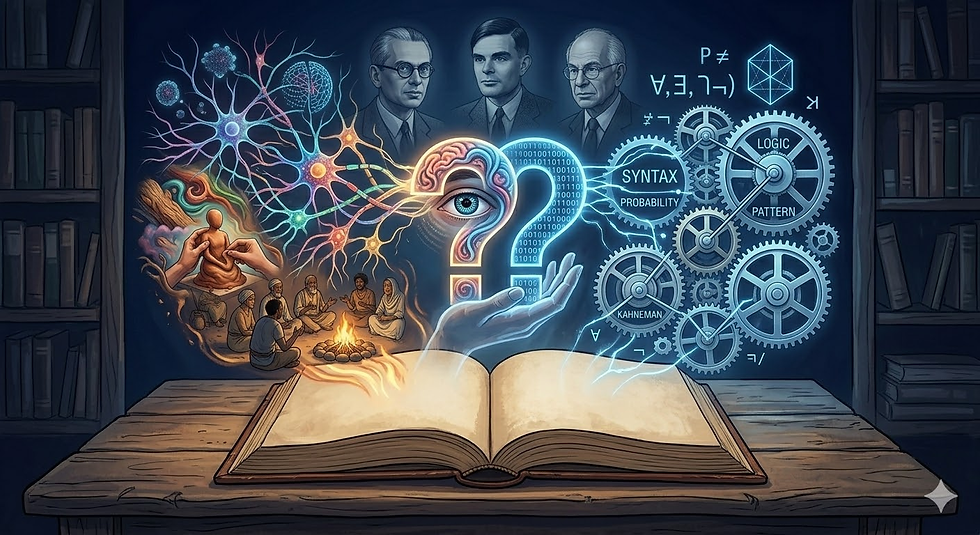
However, a deeper look through the lenses of mathematics, philosophy, and anthropology reveals a series of critical gaps. Human reasoning is a "constantly developing" process that can jump outside formal systems to grasp new truths (Gödel, 1972).17 It is an "embodied" experience where concepts like "up" and "warm" are grounded in the body's interaction with the world (Lakoff, 1980).26 And it is a "socially situated" practice where logic is a tool for navigating a shared cultural reality.12
Dimension | Verdict on AI Reasoning | Supporting Evidence |
Functional | Yes, it mimics human output 4 | Success in coding, translation, law 1 |
Formal/Logical | Incomplete, bounded by system 16 | Halting Problem, Incompleteness Theorem 19 |
Semantic | No, lacks symbol grounding 22 | Hallucinations, Chinese Room argument 28 |
Anthropological | No, lacks social/embodied context 12 | Cognitive gadgets, situated learning 12 |
What we are witnessing is not the replication of human reason, but the birth of a new kind of "synthetic reason." Just as synthetic materials like plastic can perform the functions of wood or stone without sharing their internal structure, AI can perform the functions of logic without sharing our biological or social "wetware." This synthetic reason is powerful, fast, and scalable, but it is also brittle in ways that human reason is not. It lacks the "cognitive dissonance" that drives humans to learn and grow when their beliefs are challenged (Kahneman, 2011).7
In the end, the question might be less about whether AI "really" reasons and more about how its synthetic reason will reshape our own. As we rely more on these models, we risk narrowing our definition of intelligence to only those things a machine can do: the efficient, the predictive, and the linguistic. The challenge of the coming decade will be to ensure that while we embrace the power of synthetic reasoning, we do not lose sight of the "magic ingredient" that Gödel and Lakoff pointed to: the messy, embodied, and beautifully illogical spark of the human mind.
References
Large language models present challenges for linguistics ..., accessed on March 12, 2026, http://english.cssn.cn/skw_research/linguistics/202501/t20250113_5834485.shtml
Theory Is All You Need: AI, Human Cognition, and Causal Reasoning - PubsOnLine, accessed on March 12, 2026, https://pubsonline.informs.org/doi/10.1287/stsc.2024.0189
Guest suggestion: Geoffrey Hinton (godfather of AI) : r/samharris - Reddit, accessed on March 12, 2026, https://www.reddit.com/r/samharris/comments/1onih2t/guest_suggestion_geoffrey_hinton_godfather_of_ai/
Beyond the Chinese Room: A Human-AI Dialogue on Synthetic ..., accessed on March 12, 2026, https://medium.com/@eddy.borremans/beyond-the-chinese-room-a-human-ai-dialogue-on-synthetic-understanding-d30b8cb0fd95
Why Thinking Fast and Slow is a Relevant Metaphor for Large Language Model AI - Medium, accessed on March 12, 2026, https://medium.com/intuitionmachine/why-thinking-fast-and-slow-is-a-relevant-metaphor-for-large-language-model-ai-d8c69d5173e8
accessed on March 12, 2026, https://www.microsoft.com/en-us/research/video/thinking-fast-and-slow/#:~:text=Daniel%20Kahneman%20reveals%20where%20we,more%20deliberative%2C%20and%20more%20logical.
Unlocking the Mind of AI: System 1 and System 2 Thinking in Large Language Models, accessed on March 12, 2026, https://watercrawl.dev/blog/Unlocking-the-Mind-of-AI-System-1-and-System-2
Beyond Pattern Matching - F'inn, accessed on March 12, 2026, https://www.finn-group.com/post/beyond-pattern-matching-the-quest-for-system-2-thinking-in-artificial-intelligence
System 1 and System 2 Thinking - The Decision Lab, accessed on March 12, 2026, https://thedecisionlab.com/reference-guide/philosophy/system-1-and-system-2-thinking
Exploring System 1 and 2 communication for latent reasoning in LLMs - arXiv, accessed on March 12, 2026, https://arxiv.org/html/2510.00494v1
Human- versus Artificial Intelligence - PMC - NIH, accessed on March 12, 2026, https://pmc.ncbi.nlm.nih.gov/articles/PMC8108480/
Biases, evolutionary mismatch and the comparative analysis of ..., accessed on March 12, 2026, https://pmc.ncbi.nlm.nih.gov/articles/PMC11858747/
Can philosophy help us get a grip on the consequences of AI ... - Aeon, accessed on March 12, 2026, https://aeon.co/essays/can-philosophy-help-us-get-a-grip-on-the-consequences-of-ai
Thinking, Fast and Slow - Wikipedia, accessed on March 12, 2026, https://en.wikipedia.org/wiki/Thinking,_Fast_and_Slow
The Subject of Emergent Misalignment in Superintelligence: An Anthropological, Cognitive Neuropsychological, Machine-Learning, and Ontological Perspective - arXiv.org, accessed on March 12, 2026, https://arxiv.org/html/2512.17989v2
Beyond Gödel and Turing: The Limits of Logic in a Self-Modifying AI - ResearchGate, accessed on March 12, 2026, https://www.researchgate.net/publication/388846747_Beyond_Godel_and_Turing_The_Limits_of_Logic_in_a_Self-Modifying_AI
Intuition and Ingenuity: Gödel on Turing's “Philosophical Error” - MDPI, accessed on March 12, 2026, https://www.mdpi.com/2409-9287/7/2/33
Philosophy of artificial intelligence - Wikipedia, accessed on March 12, 2026, https://en.wikipedia.org/wiki/Philosophy_of_artificial_intelligence
Reasoning and Knowledge. The Unreasonable Effectiveness of… | by CP Lu, PhD | Medium, accessed on March 12, 2026, https://cplu.medium.com/reasoning-and-knowledge-80a02ec6c75b
In 1972 Kurt Gödel publishes a short remark entitled "A philosophical error in Turing's work - HUJI OpenScholar, accessed on March 12, 2026, https://openscholar.huji.ac.il/sites/default/files/oronshagrir/files/copeland_and_shagrir_turing_vs_godel_final_0.pdf
(PDF) Godel on the mathematician's mind and Turing Machine - ResearchGate, accessed on March 12, 2026, https://www.researchgate.net/publication/338406351_Godel_on_the_mathematician's_mind_and_Turing_Machine
The Chinese Room re-visited: How LLM's have real ... - LessWrong, accessed on March 12, 2026, https://www.lesswrong.com/posts/PpCHgKsg2xDdPDQhu/the-chinese-room-re-visited-how-llm-s-have-real-but
Chinese room - Wikipedia, accessed on March 12, 2026, https://en.wikipedia.org/wiki/Chinese_room
LLMs, Turing tests and Chinese rooms: the prospects for meaning in large language models - Taylor & Francis, accessed on March 12, 2026, https://www.tandfonline.com/doi/pdf/10.1080/0020174X.2024.2446241
On the Bodily Basis of Human Cognition: A Philosophical Perspective on Embodiment, accessed on March 12, 2026, https://pmc.ncbi.nlm.nih.gov/articles/PMC8692281/
Embodied Cognition (Stanford Encyclopedia of Philosophy/Fall 2011 Edition), accessed on March 12, 2026, https://plato.stanford.edu/archives/fall2011/entries/embodied-cognition/
Cognition and the embodiment of geometry in George Lakoff's metaphors, accessed on March 12, 2026, https://geometrymatters.com/cognition-and-the-embodiment-of-geometry-in-george-lakoffs-metaphors/
LLM hallucinations and failures: lessons from 5 examples - Evidently AI, accessed on March 12, 2026, https://www.evidentlyai.com/blog/llm-hallucination-examples
LLM Hallucination Examples: What They Are and How to Detect Them - Factors.ai, accessed on March 12, 2026, https://www.factors.ai/blog/llm-hallucination-detection-examples
Embodied Cognition and Artificial Intelligence: Neural Binding, Play-Based Learning and the Path to Superintelligence - ResearchGate, accessed on March 12, 2026, https://www.researchgate.net/publication/399110969_Embodied_Cognition_and_Artificial_Intelligence_Neural_Binding_Play-Based_Learning_and_the_Path_to_Superintelligence
Conceptual Metaphor Theory as a Prompting Paradigm for Large Language Models, accessed on March 12, 2026, https://arxiv.org/html/2502.01901v1
Reading children's moral dramas in anthropological fieldnotes: A human–AI hybrid approach | Cambridge Forum on AI: Culture and Society, accessed on March 12, 2026, https://www.cambridge.org/core/journals/cambridge-forum-on-ai-culture-and-society/article/reading-childrens-moral-dramas-in-anthropological-fieldnotes-a-humanai-hybrid-approach/66341B0CAC7E8192FD1F3CA3E8BE106F
Embodied cognition - Wikipedia, accessed on March 12, 2026, https://en.wikipedia.org/wiki/Embodied_cognition
Medical Hallucination in Foundation Models and Their Impact on Healthcare - medRxiv, accessed on March 12, 2026, https://www.medrxiv.org/content/10.1101/2025.02.28.25323115v1.full
(PDF) Cultural tendencies in generative AI - ResearchGate, accessed on March 12, 2026, https://www.researchgate.net/publication/391856548_Cultural_tendencies_in_generative_AI
The Evolution of AI: Beyond Symbolic Manipulation to Embodied Cognition | by Jake Miller, accessed on March 12, 2026, https://medium.com/@jakemillerindy/the-evolution-of-ai-beyond-symbolic-manipulation-to-embodied-cognition-a1e8716e6b62
LLM Hallucination Examples - Arize AI, accessed on March 12, 2026, https://arize.com/llm-hallucination-examples/


Comments